The next great divide in biology will not fall between fields or institutions. It will fall between scientists who can use AI and those who cannot.
I do not offer that as a slogan. I offer it as the operating reality of how we now run research. AI has moved from a curiosity to the substrate of our daily work, and the gap between labs that grasp this and labs that do not is already widening.
We use AI to do less and learn more
The goal of applying AI in our lab is not novelty. It is leverage. We use it to operationalize and automate preclinical R&D, so we reach results faster and run fewer experiments. Every experiment we avoid is time, money, and animal life we preserve. AI helps us decide which experiments are worth running and which we can already answer from what we know.
A note on frontier models
I want to be precise about what we do and do not do. Frontier drug discovery models now exist for protein design, structure prediction, and molecular modeling. We do not use them yet. Our programs have not reached the sophistication those tools demand, and pretending otherwise would be dishonest. We applaud the teams building and deploying them, and we expect to adopt them as our work matures. Knowing the limit of your own capability is part of using AI well.
AI inside our workflows
What we do use, every day, is AI woven into our systems. It compresses our experiment cycles by handling operational work that used to stall them. It catches writing mistakes before they reach a reviewer or a journal. It runs a first-pass review of protocols, analyses, and drafts. Most valuable of all, it pulls insights across every dataset we have generated and surfaces connections we would never have found by hand. New ideas now emerge from old data.
This last capability changes the economics of discovery. Our data stops being a record of finished work. It becomes a living resource we query for the next hypothesis. A lab that integrates its data and interrogates it with AI compounds its own knowledge over time.
What we are seeing in practice
At the time of writing, we are one of the few labs at our institution, perhaps the only one, running genuinely AI-native workflows. That position lets us watch the divide form in real time. We are accelerating, and near-peer groups of comparable talent and resources are falling behind quickly. The difference is not ability. It is whether AI is woven into how the work gets done.
The effect on our finances is just as clear. Academic research funding is contracting, and every lab is asked to do more with fewer dollars. AI lets us be far more capital efficient with the money we have. We run fewer, better experiments, automate work that once required more hands, and extract more value from data we already paid to generate. In a tight funding climate, that efficiency is not a convenience. It is survival.
The policy problem
There is a contradiction I cannot ignore. The same institution where we run these workflows currently restricts AI use in the classroom and on submitted materials. I understand the concerns behind such policies, but I think this one is a serious mistake. It handicaps exactly the training the next generation of scientists needs most.
We cannot tell trainees that AI fluency will define their careers and then forbid them from building it where they learn. A blanket ban does not protect rigor. It delays the moment a young scientist becomes competent with the tools their field already runs on. Policy should teach responsible, skilled use, not prohibition, because prohibition only guarantees that our trainees graduate behind.
The trainee imperative
This is why I am blunt with trainees. Learn AI now. Do not wait for a course, a mandate, or permission. Scientists entering the field today will spend their careers where AI fluency is assumed, the way statistics and molecular cloning are assumed now. A trainee who masters implementation will outpace peers who treat AI as someone else's tool.
The risk is not that AI replaces scientists. The risk is that scientists who use AI replace those who do not. That gap is already opening, and it widens fastest among early-career researchers, who have the most time to compound the advantage.
The coming divide
I believe the future of biomedical science will be powered by AI, and I believe the future of biology will be decided by who can use it. The reasoning is simple. AI accelerates discovery and engineering by such a margin that an unaided lab cannot keep pace with an AI-native one. Two groups of equal talent will diverge sharply when only one of them operationalizes AI.
We are building Powerhouse and working in the Huang Lab on the assumption that this divide is real and forming now. We would rather be early and imperfect than late and left behind.
Closing
The tools will keep improving, and the frontier models will come within our reach. The premise will not change. Biology is becoming an engineering discipline accelerated by AI, and the scientists who learn to wield it now will write the next chapter. The rest will read it.
The views expressed in Perspectives are those of the author and are intended to spark
discussion. They do not constitute medical advice.
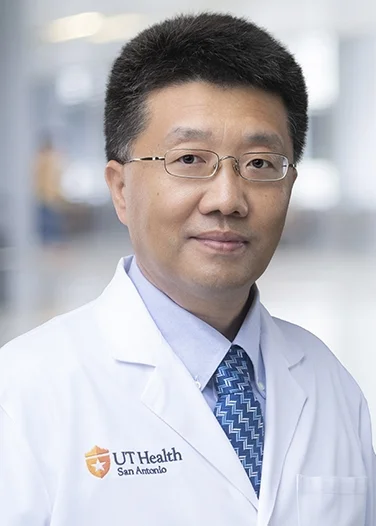 Gang HuangPrincipal Investigator, Huang Lab · Mays Cancer Center, UT Health San Antonio