For a long time, a scientific career had a clear shape. You picked one protein or one gene, you drilled into it, and you went deep enough to publish a long string of papers across decades. Depth was the whole game, and the field rewarded it. That path produced extraordinary basic science, and it built durable careers along a single line of inquiry.
That model is fading, at least in biomedical research. The new wave is innovation and translation. Labs, and the trainees building careers inside them, are now expected to identify a gap in the literature themselves and build it into a thesis that delivers more than a discovery. The work is meant to translate, to change how patients are diagnosed, treated, or understood in the clinic. That impact can take many forms, and drug discovery is only one of them. This is not yet true of every lab. It is clearly the direction of travel.
What the work is for
The change runs deeper than method. It reaches the purpose of the work. The goal is not to make money, and anyone chasing money has far easier ways to find it than this profession. The goal is to move discovery out to the people who will benefit. You take the science you spent your thesis building and you carry it toward the clinic.
There is an obligation hiding in that sentence. Much of this work runs on public money, whether NIH, DOD, or NSF. We owe the taxpayers who funded the work a return that reaches them as better medicine, not only as a paper they will never read. Translation is how we close that loop.
The status quo has moved
The default destination for a trained scientist has shifted. The status quo is no longer sitting at a bench and pipetting all day to generate basic-science data. The status quo now includes industry, business development, and the commercialization of biomedical research. It means getting drugs and devices to market and into the clinic.
I would challenge any university to run the numbers honestly. Track your own graduates. Count how many move from PhD to postdoc to a tenure-track faculty position, the path the training is implicitly built around. Then count how many land everywhere else, in industry, startups, policy, venture, and translational roles that reach patients directly. The academic-track number is small, and it has been shrinking for years. The other paths are where most graduates already go, and many of them deliver as much impact as a faculty post, or more.
If the destinations have changed and the training has not, that is a failure of the program, not the student. We are preparing people for a career most of them will never hold, then acting surprised when they leave for the one they actually enter.
This is why a new idea has taken hold, the innovation PhD. Students learn to think and act as innovators rather than only as bench scientists. As the funding landscape tightens, especially in the current NIH and NSF environment, US institutions are moving toward a model that several European programs have already largely mastered.
Personalize the training
If the goal changes, the training has to change with it. We cannot keep running every student through the same pipeline and expect different careers to emerge. Graduate education should start from what the student actually wants to do, then build the path and the opportunities around that aim.
Those paths look different from one another. One student licenses intellectual property to a pharmaceutical company. Another starts a company. A third partners with firms, large or small, to carry a device or a therapeutic to the people who need it. Universities need to pivot and train students to do this work, not stumble into it after graduation.
Bench scientist versus innovator
The distinction is not about talent or rigor. Both demand plenty of each. The difference is where the work is aimed. The bench scientist asks what is true and stops when the question is answered. The innovator asks what is true and then asks what that truth can do, who it can reach, and what has to be built to get it there.
A bench scientist optimizes for the next clean result. An innovator optimizes for impact, and treats the result as the start of a longer chain rather than the end of one. The skills overlap heavily, and the best innovators are excellent scientists first. The shift is one of mindset and destination. We have trained generations to be superb at the first stance and left the second to chance. That is what has to change.
I am not arguing that everyone should become an innovator, or that the bench scientist has no place. We will always need deep, patient, fundamental work, and some of the most important discoveries will come from people who never want to start a company. The argument is that we should stop training everyone as though the bench is the only destination, when for many of them it is not.
The funding objection
The obvious objection is money. Funds are already limited, so how does a university take on more. The answer is that commercialization is not only a cost. It is a source of revenue. Commercializing the discoveries already sitting on the shelf generates returns for the institution. Done well, that revenue can fill the gap left by shrinking federal support, and it can sometimes exceed it.
This reframes commercialization as part of the university's financial survival, not a distraction from its mission. The discoveries are already made. The question is whether they reach patients and generate the return that funds the next discovery, or whether they sit unused.
How we work
This is the model the Huang Lab has taken on. We have spun off multiple biotech companies and startups to commercialize the work we do. We partner directly with pharma, we work on drugs already in clinical trials, and we push our own programs toward the clinic, whether run by us or sponsored by a partner.
We hold this in mind on every project. We ask early how the science reaches patients, who carries it there, and what structure moves it fastest. The discovery matters, and so does its delivery. Both belong to the work.
Closing
The innovation PhD is not a rejection of deep science. It is an insistence that deep science finish its journey. We have always owed patients and taxpayers more than a paper, and what has changed is that we can finally carry that depth all the way to the clinic. The scientists we train next should know how to make that journey, because the era that rewarded depth alone is ending.
The views expressed in Perspectives are those of the author and are intended to spark
discussion. They do not constitute medical advice.
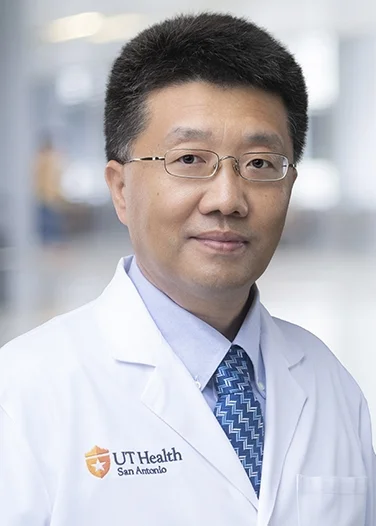 Gang HuangPrincipal Investigator, Huang Lab · Mays Cancer Center, UT Health San Antonio